
Gemini is Google's family of AI models — powering the Gemini app, AI Overviews in Search, and AI features inside Workspace. To get surfaced, structure content as direct answers to real questions, add FAQ and schema markup, and cite concrete evidence. Gemini pulls from indexed pages, so strong technical SEO is still the price of entry, not a replacement for it.
I'm Alex, and I write for Grid13, a platform that builds SEO- and GEO-optimized blog posts to keep businesses visible across Google and AI answer engines. We spend our days watching what gets cited and what gets ignored. This piece is the honest version of what we tell clients about Gemini — no hype, and every number below is linked to where it came from.
What Gemini actually is — and why it changed content discovery
Gemini is not one product. It's the model layer underneath several things you already touch: the standalone Gemini app, the AI Overviews that now sit above the blue links in Search, and the AI help inside Gmail, Docs and Sheets. Google Gemini launched on February 8, 2024, and the adoption curve since then is the reason marketers can't treat it as a side experiment.
The scale is the story. The Gemini app passed 950 million monthly active users by Q2 2026, and AI Overviews inside Search reach more than 2.5 billion monthly users. That second number matters more for most businesses: it means Gemini's summaries are being served on the same search results your customers already visit.
How is Gemini different from traditional search?
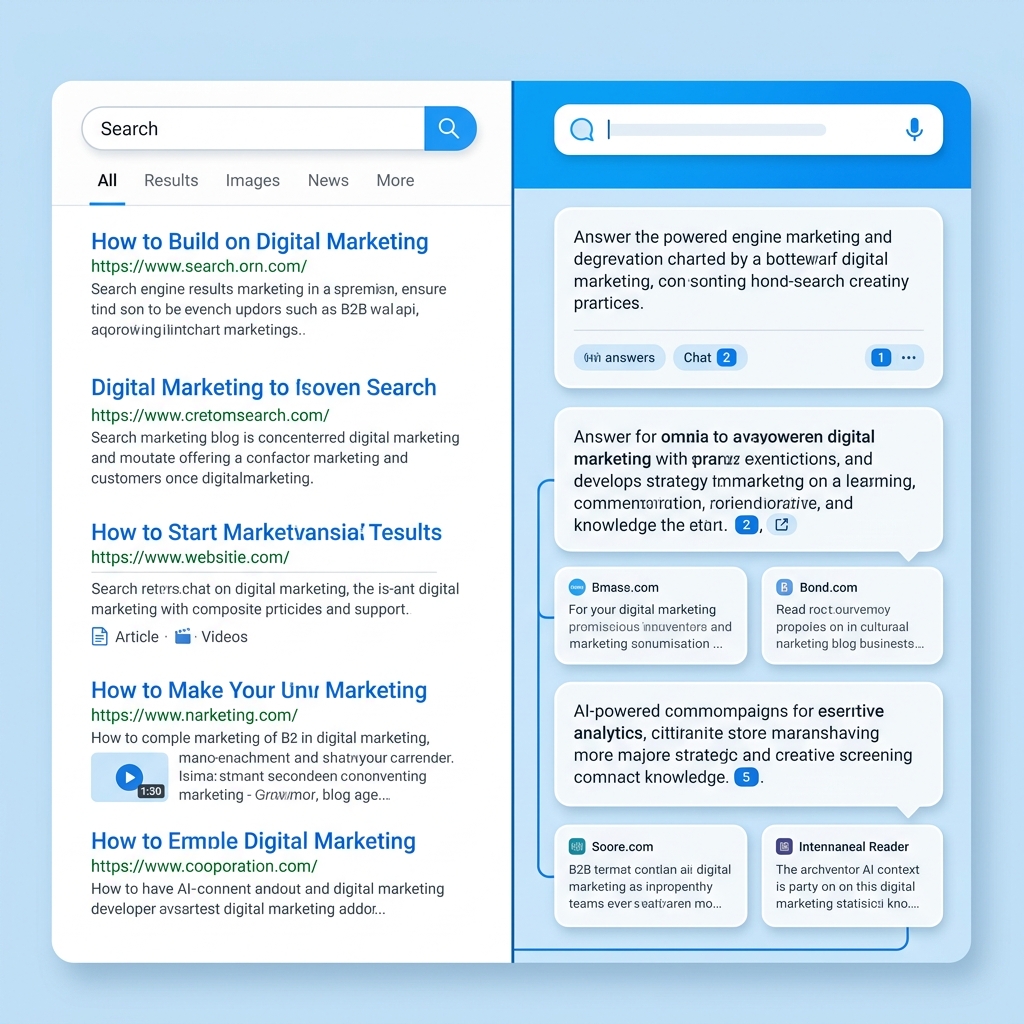
Traditional search hands the user ten links and lets them choose. Gemini reads the top sources, synthesizes an answer, and shows a short summary with a handful of citations. The user often gets what they need without a click.
That shift has a cost you should plan for. AI Overviews grew from roughly 15% of Google searches to 43% over the past year, and studies show an average 34.5% drop in organic click-through rate when an AI overview is present. Fewer people click. But Google also reported AI Overviews drive over a 10% increase in search usage in more than 200 countries and territories for the query types where they appear. So the pie is growing while each slice gets thinner. The winning move is to be one of the cited sources, not to fight the format.

What NOT to do
Do not chase Gemini with keyword-stuffed thin pages or AI-spun filler. We've watched those pages get indexed and then quietly ignored — Gemini favors sources it can extract a clean, factual answer from. A 400-word page that repeats one phrase eight times gives it nothing to lift.
How to optimize content for Gemini this week
Here is a method you can run in a single week, with the actual tools named. None of this requires a big budget.
- Find the real questions. Open Google Search Console, filter Performance by queries containing "how," "what," "why," and "best." Those are the phrasings Gemini answers. Cross-check with the People Also Ask boxes on your target keyword.
- Answer in the first 60 words. Put a direct, standalone answer at the top of the section — the kind Gemini can quote without editing. Then expand below it.
- Add an FAQ block with schema. Mark up questions with FAQPage JSON-LD so machines can parse each Q&A pair. This is one of the highest-leverage 30-minute jobs on any page.
- Cite evidence. Name a source, link it, and give a specific number. Gemini rewards pages that read like they know something, and it tends to pull sentences that carry a verifiable fact.
- Verify indexing. Use the URL Inspection tool in Search Console. If a page isn't indexed, Gemini can't cite it — indexing is the floor.
A prompt to test whether Gemini already sees you
Open the Gemini app and ask it the exact question your customer would: for example, "What's the best [your product category] for a small business, and why?" Note which brands and URLs it cites. Then ask, "What sources did you use?" We run this check monthly for clients — it's the closest thing to a live scoreboard for AI visibility, and it costs nothing.
Where Gemini touches your business beyond Search
Gemini's reach into Google Workspace changes the buyer's context, not just their search. In January 2025 Google restructured Workspace pricing to bundle Gemini features in, dropping the Business Standard price from $32 per user per month to $14 per user per month. On the enterprise side, Google sold more than 8 million Gemini Enterprise seats across over 2,800 companies. Your buyers are increasingly drafting, summarizing and researching inside Gemini-powered tools — which means the answer Gemini gives about your category is shaping opinions before anyone lands on your homepage.
If you build on the technical side, the API pricing is worth knowing: Gemini API rates in 2026 range from $0.10 per million input tokens on Flash-Lite to $2.00 per million on 3.1 Pro, and Google cut the Ultra subscription from $249.99 to $99.99. The direction is clear — Google is making AI access cheaper to widen the funnel, which pushes more queries through Gemini, not fewer.
Gemini optimization techniques that drive business results
The techniques that move the needle are the same ones that make a page genuinely useful — Gemini just rewards them more visibly than the old ten-blue-links layout did.
- Entity clarity. State plainly who you are and what you do, in text a machine can read. "Grid13, an AI blog-post platform for improving SEO and GEO scores," tells Gemini exactly how to categorize us.
- Structured formatting. Numbered steps, short lists and tables are easier to extract than dense paragraphs. Gemini lifts these cleanly.
- Original, specific data. A number from your own testing or a named external source outranks a vague claim every time. Round facts get ignored; precise ones get cited.
- Freshness. Update pages when the facts change. A page that still quotes 2024 numbers in 2026 looks stale to both users and models.
This is exactly the workload we automate at Grid13 — building posts that carry direct answers, FAQ schema and cited data by default, so they're eligible for Gemini citations the day they publish rather than months later.
Frequently Asked Questions
Does traditional SEO still matter if I optimize for Gemini?
Yes — completely. Gemini builds its answers from Google's index, so a page that isn't crawled, indexed and technically sound can't be cited no matter how well it's written. Solid SEO is the entry ticket, and Gemini optimization is what you add on top.
Will AI Overviews kill my organic traffic?
They'll change it. Research shows an average 34.5% drop in click-through rate when an AI overview appears, but Google also reported AI Overviews lift overall search usage by more than 10% for the queries where they show. Being a cited source protects your visibility better than avoiding the format ever could.
How do I check whether Gemini already cites my business?
Ask the Gemini app your customer's actual question, then ask it which sources it used. Do this monthly and track which URLs appear. It's a free, repeatable way to see your standing in AI answers without paying for a monitoring tool.
How big is Gemini's reach right now?
By Q2 2026, Gemini's app reached 950 million monthly active users, while Search's AI Overviews extended to 2.5 billion monthly users. For most businesses the Search integration is the bigger opportunity, because it meets people on results pages they already use.
What's the single fastest change I can make for Gemini visibility?
Add a 40-to-60-word direct answer at the top of your most important page, then mark up a short FAQ section with FAQPage schema. Both are quick to implement and give Gemini clean, extractable text to quote.